
AI & automation
AI agent or workflow automation for an Australian small business
Start with a fixed workflow when the steps are known. Add AI where a task needs to interpret messy text. Consider an agent when the system genuinely needs to choose its next step. For an Australian small business automating customer enquiries, that distinction can keep the first project focused and give you clearer questions to ask a supplier.
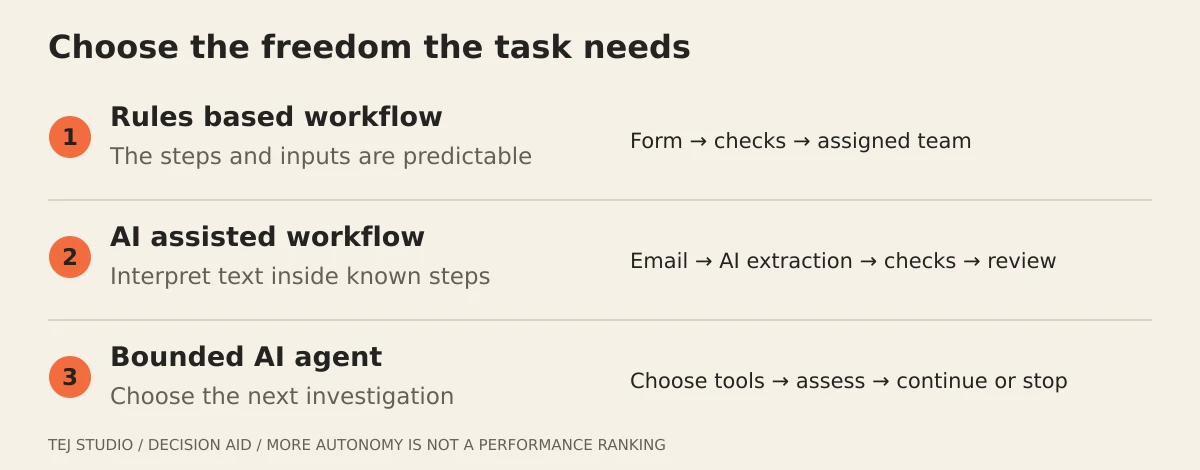
Choose how much freedom the job needs
A rules-based workflow follows instructions you define: receive a form, check required fields and assign the enquiry by service area. It may need no AI at all.
An AI-assisted workflow keeps that fixed structure but uses a model for a specific step, such as extracting a requested service from an email. The output still needs validation because a model can misread a request.
An agent can decide which approved tool to use next and change its approach as it finds information. Unlike a predefined workflow, an agent lets a model direct the process. Start with the simplest approach that works.
Our recommendation: choose the least autonomy that handles your actual exceptions. A long process does not automatically need an agent.
Apply the choice to one enquiry
Imagine a Brisbane maintenance business receiving enquiries through a website and shared inbox. This is an illustrative scenario.
If customers select a service and postcode on a form, ordinary rules may be enough to create a job request and route it to the right team.
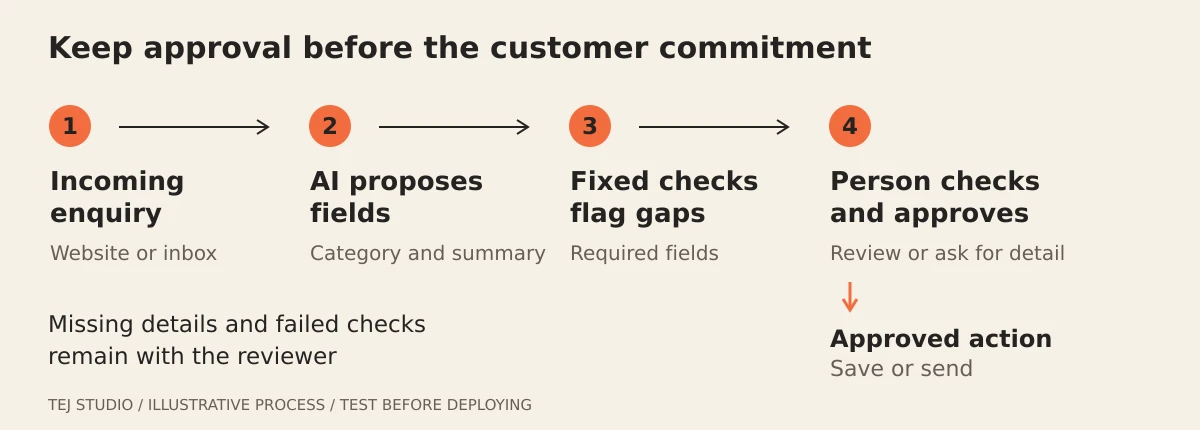
If emails describe the job in different ways, an AI step could extract a proposed service category and summarise the request. A fixed workflow can then check required fields and place incomplete or uncertain cases in a review queue.
An agent becomes worth testing when an enquiry requires different investigations: perhaps checking approved service information, finding an existing job and deciding which missing detail matters next. Start by letting it prepare a recommendation for a person. Keep quotes, appointment commitments and outgoing replies subject to approval during the pilot.
Set boundaries before connecting tools
List what the system may read, what it may change and when it must stop. Give it access only to the records needed for the job. Decide who handles failures, and make sure staff can pause the automation and continue manually.
Set clear accountability, test the system, monitor its operation and keep meaningful human control. Use those principles to shape the pilot, rather than treating a successful demonstration as launch approval.
Check data handling before putting customer information into a tool. Assess its suitability, the human oversight needed and who can access personal information. As a cautious practice, avoid entering personal information, especially sensitive information, into publicly available generative AI tools. Confirm the obligations that apply to your business.
Ask for a pilot you can evaluate
Before approving a build, ask the supplier to document:
- The exact task, connected systems and permitted actions
- Examples of normal cases, missing details and unusual requests
- How incorrect outputs, duplicate actions and unavailable systems are handled
- Who reviews exceptions, monitors results and maintains integrations
- Setup costs, ongoing usage costs and the work your team will still do
Agree success criteria before testing. Compare the pilot with your current process using handling time, corrections and missed or misrouted enquiries. Include review time and service costs. Use synthetic examples or appropriately approved data, and test failures as well as successful cases.
Put the thinking to work.
If you are choosing a first project, explore Tej Studio’s AI and workflow automation approach, or bring one workflow to a scoping conversation. Start with the task, the exceptions and the people responsible for the result.
Explore AI and workflow automation Start a conversation