
Software & technology
Customer portal or email for your service business
A customer asks which document is current. Someone else wants a progress update. Your team checks an inbox, opens a spreadsheet and sends another reply. If that routine keeps repeating, a customer portal may deserve a place in your plans. For Australian service businesses comparing customer portal development, the useful starting point is one recurring customer task. Work out what customers should be able to see or do, then compare the simplest ways to provide it.
When email and spreadsheets still work
Email can suit occasional, personal conversations. A shared spreadsheet can be enough when a small team owns the process, updates it consistently and does not need to expose different records to different customers.
Consider a portal when customers repeatedly need the same information, several staff handle each request, or permissions vary by customer. Count the follow-ups and time spent finding answers before deciding. A new login will add friction if customers rarely need to use it.
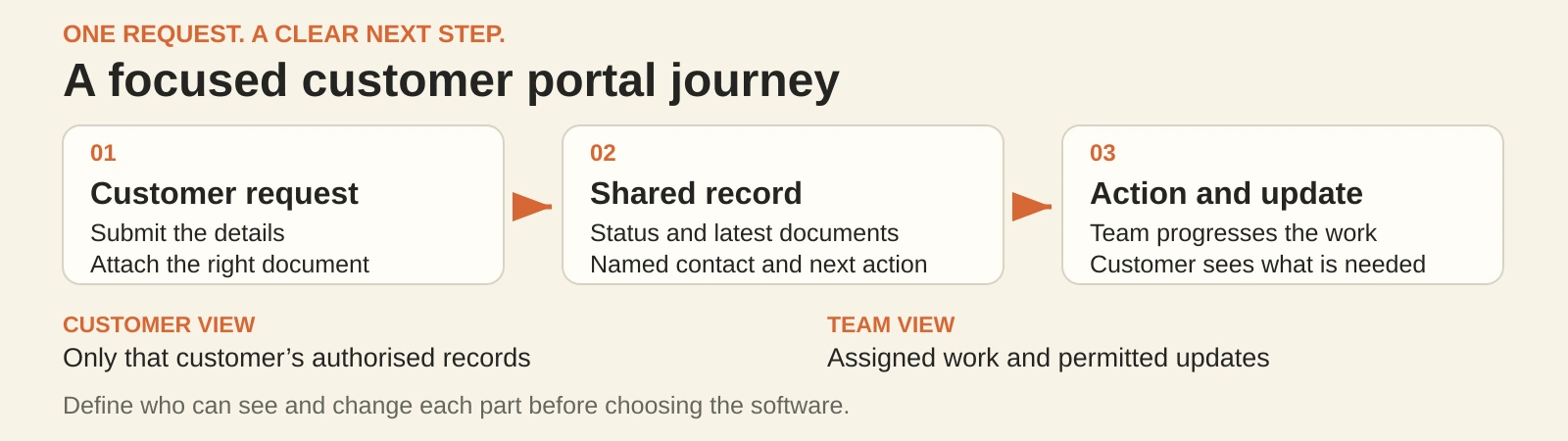
Scope one complete customer journey
Choose a journey such as submitting a service request and tracking its progress. Write down the customer steps, the staff response and what happens when something goes wrong.
A focused first release might include:
- Individual customer accounts and access limited to their organisation
- A request form with only the information needed to start work
- A clear status, named team contact and next action
- Document upload and download, with version labels
- Notifications that bring customers back when action is needed
- A staff view for updating records and resolving exceptions
Decide which existing system owns each piece of information. For example, if your job-management system owns the job status, specify how the portal receives updates and shows a failed sync. Avoid asking staff to maintain two competing versions.
Compare buying and building
Check whether your current business software already offers a customer-facing area. Test it with a real task before commissioning something new.
A configurable portal may suit standard requests and document exchange. Custom development becomes worth considering when the customer journey, permissions or integrations cannot be handled well by existing options. Compare setup effort, ongoing fees, data export and maintenance responsibilities across both approaches.
Custom software development should begin with these requirements so the proposed solution can be judged against the work it needs to support.
Put privacy and access in the brief
Ask for individual accounts, multi-factor authentication, access limited to each role, and a clear way to remove access when someone leaves. Test that a customer cannot open another customer’s records by changing a link or record number.
Specify encryption, activity records, backups and a tested recovery process. Confirm where information and backups are stored, which providers can access them, and how long records are retained.
Australian privacy obligations depend on the business and the information involved. Some small businesses are covered by the Privacy Act even below the usual turnover threshold. Get advice for your circumstances, particularly for sensitive information. Australian hosting alone does not settle every privacy requirement.
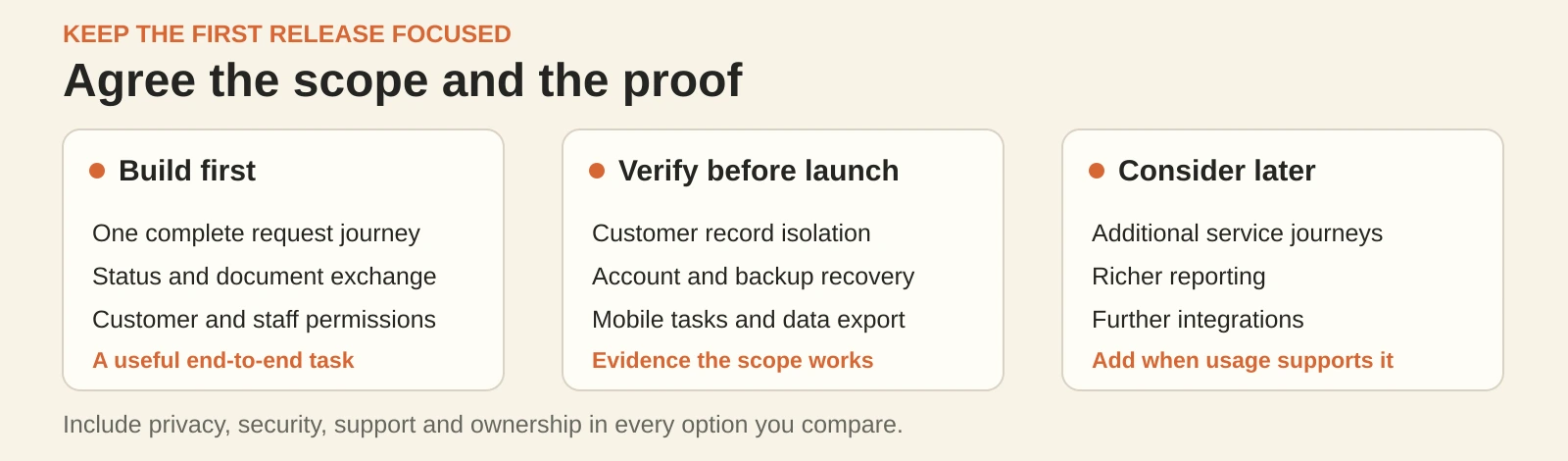
Ask for a quote you can compare
Give each supplier the same journey, user roles, integrations and acceptance tests. Ask them to separate discovery, design, development, migration, hosting, support and third-party fees. Confirm whether quoted amounts include GST and which assumptions could change the price.
Include account recovery, mobile usability and accessibility in the scope. Ask who handles software updates and incidents, how changes are priced, and what files and documentation you receive at handover. Request a demonstration of exporting your records before committing.
Introduce it with a small customer group
Start with one service and a manageable group of customers. Keep a support route available while you check whether people can complete the task without help.
Measure completion rates, repeated enquiries and staff handling time against your starting point. Fix the points of confusion before expanding the portal.
Ready to explore the scope? Talk to Tej Studio about your customer journey, existing systems and the outcome you want the first release to achieve.
Put the thinking to work.
Discuss what these questions mean for your product or business.
Custom software development Start a conversation