
OTT & media
Video caption workflows to agree before platform launch
Before approving a video platform build, agree who creates captions, who checks them and who can correct them after launch. Ask for a demonstration using one of your permitted video files, including a deliberate correction. Put the editable files, approval steps and ongoing responsibilities in the scope. For an Australian publisher, training business or specialist media service, a video caption workflow connects content production to platform operations. It matters when a catalogue grows, an episode changes or viewers report a mistake. A launch quote should explain how that work will happen.
Name the outputs your audience needs
Captions represent speech and meaningful sounds in time with the video. They may need speaker identification or a sound cue that explains the scene. A dialogue translation serves a different audience need, even though platforms and regions sometimes use the word subtitles for both. Define the required content and language rather than relying on the label.
A transcript provides a separate text version. Where visual information is necessary to understand the programme, a descriptive transcript includes that information too. Decide whether transcripts and audio description belong in the project, with appropriate accessibility advice. Caption support alone does not establish that the whole service is accessible.
Start with a catalogue inventory: title, language, final video version, existing caption file and review status. Mark missing or unapproved material. This gives the supplier a concrete workload to price and schedule.
Keep editable files alongside the video
Closed captions can be switched on or off. Open captions are always visible; when text is burned into the video image, changing it requires a new video export. Ask for editable caption files and the approved video master to be retained, even if some promotional clips use burned-in text.
Have the supplier specify accepted upload formats, any conversion and the formats delivered to each supported player. For example, Apple's HTTP Live Streaming (HLS) guidance supports WebVTT and IMSC1 subtitle delivery and requires language information in the relevant playlist declarations. An upload form accepting a file does not prove that the complete delivery chain handles it correctly.
Confirm that your team can export the agreed caption assets and identify which video version each belongs to. Put any storage, conversion or external captioning service in the quote. These are scope questions, not assumptions about features every platform includes.
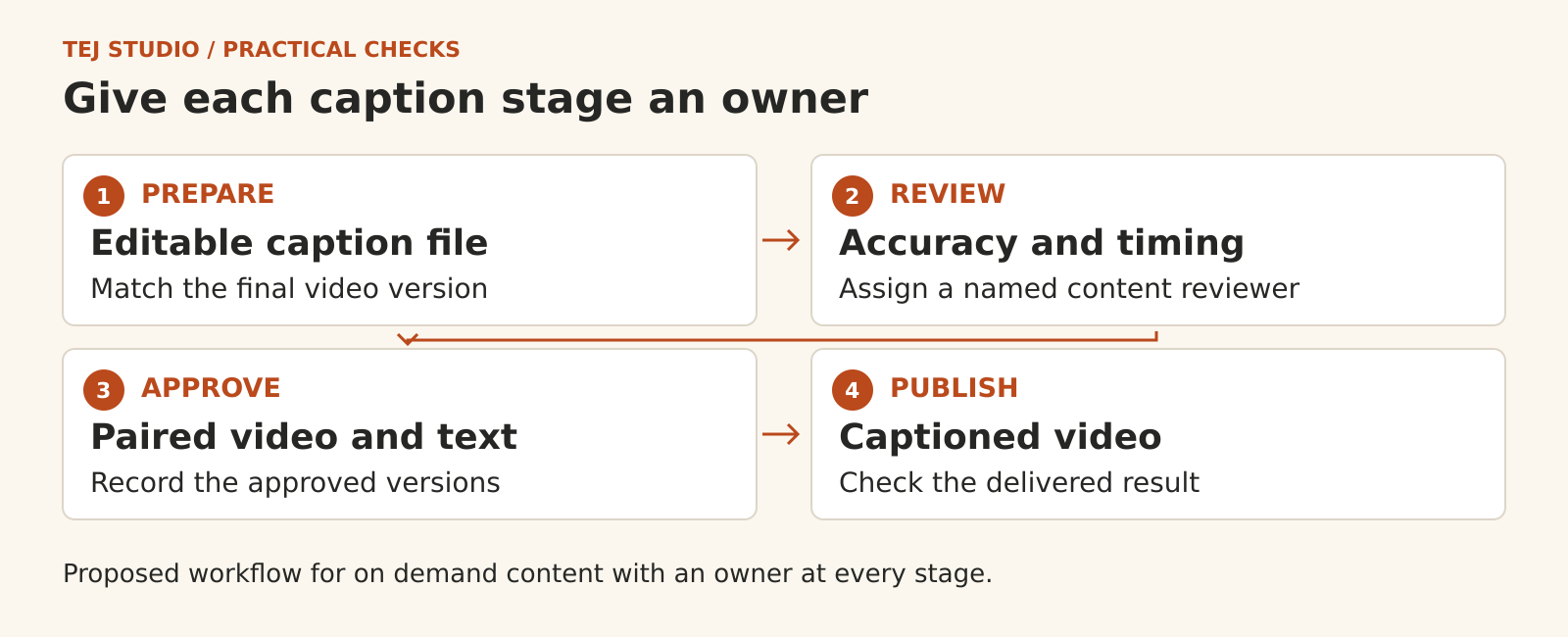
Give automatic captions a review stage
Automatic captions can supply a starting draft. They still need a person to check accuracy before publication. Review names, Australian place names, technical terms, overlapping speakers and meaningful sounds. Check timing against the final edit, especially where the programme has been shortened or rearranged.
Separate content approval from the upload task. The person operating the platform may not know whether a specialist term is correct. Name a content reviewer, a publishing owner and a backup, and decide what happens if approval is late.
Ask the supplier to show distinct draft, approved and published states, or explain the equivalent process your team will use. The important outcome is that an unreviewed file cannot be mistaken for the agreed final version.
Plan corrections and replacement edits
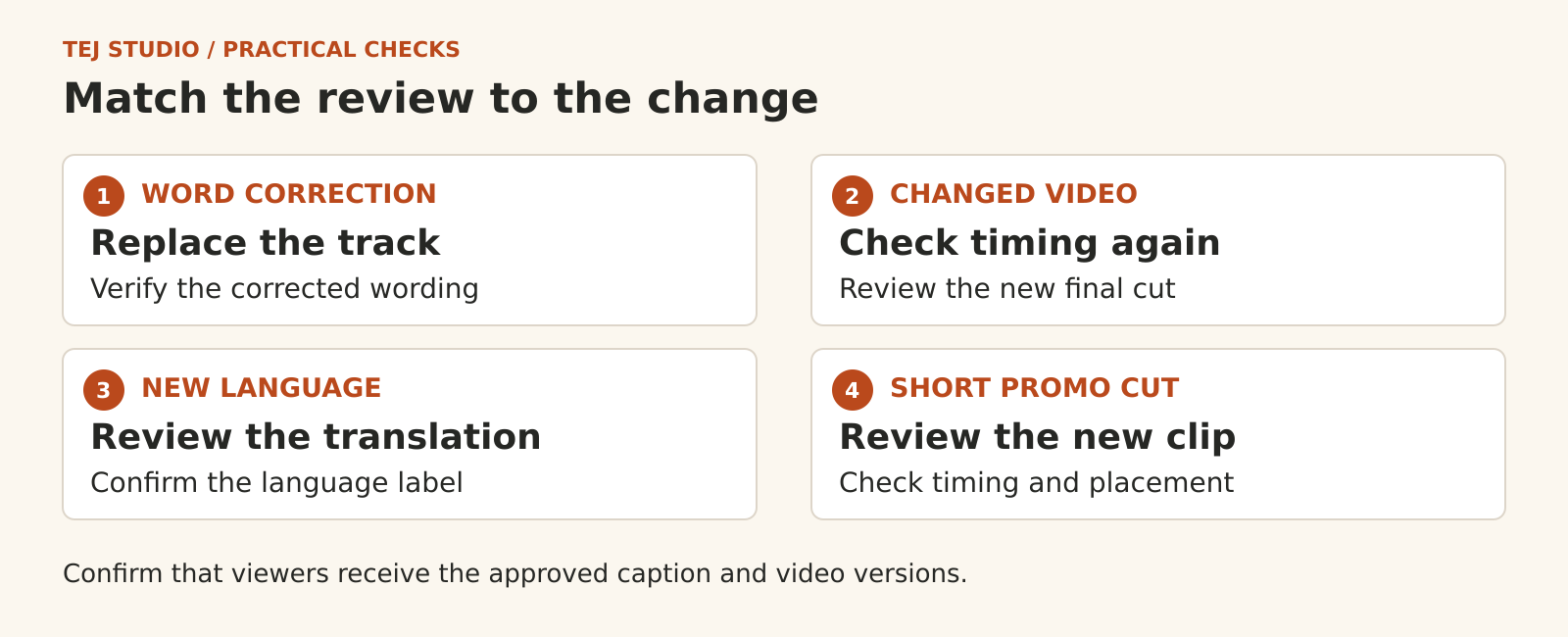
Use an illustrative case: an interview caption misspells a guest's name. The content owner corrects the editable file and records the change. The publisher replaces the track, then checks the actual viewer experience on the affected delivery paths. Agree how the team confirms that the corrected version is being served.
Now consider a replacement video with a shorter introduction. Its timing has changed, so the previous captions need review and may need retiming. A short promotional cut should also receive its own check. Do not treat approval of the long version as approval of every derivative.
Define who handles a reported error, who approves the correction and whether that work is included in support. Keep the approved version history and agree a way to restore the previous release if a replacement introduces a problem.
Rehearse the workflow before acceptance
Ask your content team to perform these tasks in the proposed platform, using test material:
- Upload, review and publish one captioned title through the normal process.
- Correct a word without silently replacing the wrong language or video version.
- Replace a video edit, review the timing and retrieve the approved caption files.
Inspect caption selection and readability on the devices in scope, including keyboard operation for the web player. Keep broader playback testing separate, but retain the evidence that this workflow produces the intended viewer result.
Put the thinking to work.
Planning a catalogue launch? Explore Tej Studio's OTT platform approach. Bring a content inventory and your proposed approval process so caption preparation and ongoing corrections can be scoped alongside the platform.
Start a conversation